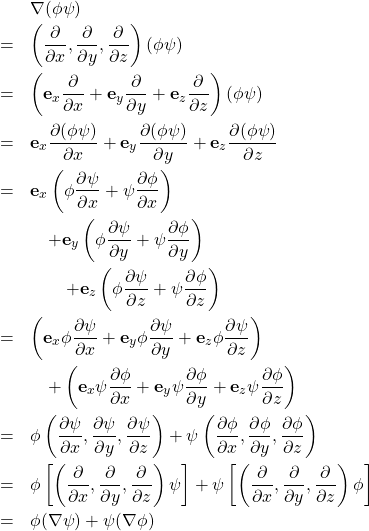
ベクトル解析の公式の一覧(ベクトルかいせきのこうしきのいちらん)では、3次元空間におけるベクトル解析の公式の一覧を与える。

内積と外積

ここで A {\displaystyle \mathbf {A} } , B {\displaystyle \mathbf {B} } , C {\displaystyle \mathbf {C} } は任意のベクトルである。また重複添え字については和を取る(アインシュタインの縮約記法)。 ϵ i j k {\displaystyle \epsilon _{ijk}} はレヴィ=チヴィタ記号、 θ {\displaystyle \theta } A {\displaystyle \mathbf {A} } , B {\displaystyle \mathbf {B} } がなす角である。

内積

A B = A i B i = A x B x A y B y A z B z = | A | | B | cos θ {\displaystyle \mathbf {A} \cdot \mathbf {B} =A_{i}B_{i}=A_{x}B_{x} A_{y}B_{y} A_{z}B_{z}=|\mathbf {A} ||\mathbf {B} |\cos \theta }
A B = B A {\displaystyle \mathbf {A} \cdot \mathbf {B} =\mathbf {B} \cdot \mathbf {A} }

外積

A × B = ( ϵ i j k A j B k ) e i = ( A y B z A z B y ) e x ( A z B x A x B z ) e y ( A x B y A y B x ) e z {\displaystyle \mathbf {A} \times \mathbf {B} =(\epsilon _{ijk}A_{j}B_{k})\mathbf {e} _{i}=(A_{y}B_{z}-A_{z}B_{y})\mathbf {e} _{x} (A_{z}B_{x}-A_{x}B_{z})\mathbf {e} _{y} (A_{x}B_{y}-A_{y}B_{x})\mathbf {e} _{z}}
A × B = B × A {\displaystyle \mathbf {A} \times \mathbf {B} =-\mathbf {B} \times \mathbf {A} }
| A × B | = | A | B | sin θ {\displaystyle |\mathbf {A} \times \mathbf {B} |=|\mathbf {A} |\mathbf {B} |\sin \theta }

スカラー三重積

A ( B × C ) = B ( C × A ) = C ( A × B ) {\displaystyle \mathbf {A} \cdot (\mathbf {B} \times \mathbf {C} )=\mathbf {B} \cdot (\mathbf {C} \times \mathbf {A} )=\mathbf {C} \cdot (\mathbf {A} \times \mathbf {B} )}

ベクトル三重積

A × ( B × C ) = ( A C ) B ( A B ) C {\displaystyle \mathbf {A} \times (\mathbf {B} \times \mathbf {C} )=(\mathbf {A} \cdot \mathbf {C} )\mathbf {B} -(\mathbf {A} \cdot \mathbf {B} )\mathbf {C} }

ヤコビ恒等式

A × ( B × C ) B × ( C × A ) C × ( A × B ) = 0 {\displaystyle \mathbf {A} \times (\mathbf {B} \times \mathbf {C} ) \mathbf {B} \times (\mathbf {C} \times \mathbf {A} ) \mathbf {C} \times (\mathbf {A} \times \mathbf {B} )=0}

四重積

( A × B ) ( C × D ) = ( A C ) ( B D ) ( A D ) ( B C ) {\displaystyle (\mathbf {A} \times \mathbf {B} )\cdot (\mathbf {C} \times \mathbf {D} )=(\mathbf {A} \cdot \mathbf {C} )(\mathbf {B} \cdot \mathbf {D} )-(\mathbf {A} \cdot \mathbf {D} )(\mathbf {B} \cdot \mathbf {C} )}
( A × B ) × ( C × D ) = [ A ( C × D ) ] B [ B ( C × D ) ] A {\displaystyle (\mathbf {A} \times \mathbf {B} )\times (\mathbf {C} \times \mathbf {D} )=[\mathbf {A} \cdot (\mathbf {C} \times \mathbf {D} )]\mathbf {B} -[\mathbf {B} \cdot (\mathbf {C} \times \mathbf {D} )]\mathbf {A} }

微分公式

ここで A {\displaystyle \mathbf {A} } , B {\displaystyle \mathbf {B} } は任意のベクトル場, f {\displaystyle f} は任意のスカラー場である。

( f A ) = f A f A {\displaystyle \mathbf {\nabla } \cdot (f\mathbf {A} )=\mathbf {\nabla } f\cdot \mathbf {A} f\mathbf {\nabla } \cdot \mathbf {A} }
( A B ) = ( B ) A ( A ) B A × ( × B ) B × ( × A ) {\displaystyle \mathbf {\nabla } (\mathbf {A} \cdot \mathbf {B} )=(\mathbf {B} \cdot \mathbf {\nabla } )\mathbf {A} (\mathbf {A} \cdot \mathbf {\nabla } )\mathbf {B} \mathbf {A} \times (\mathbf {\nabla } \times \mathbf {B} ) \mathbf {B} \times (\mathbf {\nabla } \times \mathbf {A} )}
( A × B ) = B ( × A ) A ( × B ) {\displaystyle \mathbf {\nabla } \cdot (\mathbf {A} \times \mathbf {B} )=\mathbf {B} \cdot (\mathbf {\nabla } \times \mathbf {A} )-\mathbf {A} \cdot (\mathbf {\nabla } \times \mathbf {B} )}
× ( f A ) = f × A f × A {\displaystyle \mathbf {\nabla } \times (f\mathbf {A} )=\mathbf {\nabla } f\times \mathbf {A} f\mathbf {\nabla } \times \mathbf {A} }
× ( A × B ) = ( B ) A ( A ) B A ( B ) B ( A ) {\displaystyle \mathbf {\nabla } \times (\mathbf {A} \times \mathbf {B} )=(\mathbf {B} \cdot \mathbf {\nabla } )\mathbf {A} -(\mathbf {A} \cdot \mathbf {\nabla } )\mathbf {B} \mathbf {A} (\mathbf {\nabla } \cdot \mathbf {B} )-\mathbf {B} (\mathbf {\nabla } \cdot \mathbf {A} )}
× f = 0 {\displaystyle \mathbf {\nabla } \times \mathbf {\nabla } f={\vec {0}}}
( × A ) = 0 {\displaystyle \mathbf {\nabla } \cdot (\mathbf {\nabla } \times \mathbf {A} )=0}
× ( × A ) = ( A ) 2 A {\displaystyle \mathbf {\nabla } \times (\mathbf {\nabla } \times \mathbf {A} )=\mathbf {\nabla } (\mathbf {\nabla } \cdot \mathbf {A} )-\mathbf {\nabla } ^{2}\mathbf {A} }

ヘルムホルツ分解

B = f × A {\displaystyle \mathbf {B} =\mathbf {\nabla } f \mathbf {\nabla } \times \mathbf {A} }

積分公式

ここで A {\displaystyle \mathbf {A} } , B {\displaystyle \mathbf {B} } , C {\displaystyle \mathbf {C} } は任意のベクトル場, f {\displaystyle f} , g {\displaystyle g} は任意のスカラー場である。また, V {\displaystyle V} は空間領域, V {\displaystyle \partial V} はその境界, S {\displaystyle S} は面, n {\displaystyle \mathbf {n} } はその法線ベクトル ( S = V {\displaystyle S=\partial V} の場合 n {\displaystyle \mathbf {n} } は外向きに取る), d S = n d S {\displaystyle d\mathbf {S} =\mathbf {n} dS} は面要素ベクトルである。閉曲線 S {\displaystyle \partial S} に関する線積分 d r {\displaystyle d\mathbf {r} } は法線 n {\displaystyle \mathbf {n} } に対応する向きとする。

ガウスの発散定理および関連する公式(最後の等式はグリーンの定理である)

V A d V = V A d S {\displaystyle \int _{V}\mathbf {\nabla } \cdot \mathbf {A} \,dV=\oint _{\partial V}\mathbf {A} \cdot d\mathbf {S} }
V f d V = V f d S {\displaystyle \int _{V}\mathbf {\nabla } f\,dV=\oint _{\partial V}f\,d\mathbf {S} }
V × A d V = V d S × A {\displaystyle \int _{V}\mathbf {\nabla } \times \mathbf {A} \,dV=\oint _{\partial V}d\mathbf {S} \times \mathbf {A} }
V ( f 2 g g 2 f ) d V = V ( f g g f ) d S {\displaystyle \int _{V}(f\mathbf {\nabla } ^{2}g-g\mathbf {\nabla } ^{2}f)dV=\oint _{\partial V}(f\mathbf {\nabla } g-g\mathbf {\nabla } f)\cdot d\mathbf {S} }

ストークスの定理および関連する公式

S ( × A ) d S = S A d r {\displaystyle \int _{S}(\mathbf {\nabla } \times \mathbf {A} )\cdot d\mathbf {S} =\oint _{\partial S}\mathbf {A} \cdot d\mathbf {r} }
S d S × f = S f d r {\displaystyle \int _{S}d\mathbf {S} \times \mathbf {\nabla } f=\oint _{\partial S}fd\mathbf {r} }
S ( d S × ) × A = S d r × A {\displaystyle \int _{S}(d\mathbf {S} \times \mathbf {\nabla } )\times \mathbf {A} =\oint _{\partial S}d\mathbf {r} \times \mathbf {A} }

曲線座標

曲線座標における勾配、発散、回転、ラプラシアン、物質微分の公式。

円柱座標

円柱座標 ( r , θ , z ) {\displaystyle (r,\theta ,z)} と直交座標 ( x , y , z ) {\displaystyle (x,y,z)} の変換

{ x = r cos θ y = r sin θ z = z         { r = x 2 y 2 θ = tan 1 y x z = z {\displaystyle \left\{{\begin{array}{l}x=r\cos \theta \\y=r\sin \theta \\z=z\end{array}}\right.\ \ \ \ \left\{{\begin{array}{l}r={\sqrt {x^{2} y^{2}}}\\\theta =\tan ^{-1}{\frac {y}{x}}\\z=z\end{array}}\right.}

単位基底ベクトル

e r = cos θ e x sin θ e y {\displaystyle \mathbf {e} _{r}=\cos \theta \mathbf {e} _{x} \sin \theta \mathbf {e} _{y}}
e θ = sin θ e x cos θ e y {\displaystyle \mathbf {e} _{\theta }=-\sin \theta \mathbf {e} _{x} \cos \theta \mathbf {e} _{y}}
e z = e z {\displaystyle \mathbf {e} _{z}=\mathbf {e} _{z}}

計量

d s 2 = d r 2 r 2 d θ 2 d z 2 {\displaystyle ds^{2}=dr^{2} r^{2}d\theta ^{2} dz^{2}}

体積要素

d V = r d r d θ d z {\displaystyle dV=r\,dr\,d\theta \,dz}

勾配

f = f r e r 1 r f θ e θ f z e z {\displaystyle \mathbf {\nabla } f={\frac {\partial f}{\partial r}}\mathbf {e} _{r} {\frac {1}{r}}{\frac {\partial f}{\partial \theta }}\mathbf {e} _{\theta } {\frac {\partial f}{\partial z}}\mathbf {e} _{z}}

発散

A = 1 r r ( r A r ) 1 r A θ θ A z z {\displaystyle \mathbf {\nabla } \cdot \mathbf {A} ={\frac {1}{r}}{\frac {\partial }{\partial r}}(rA_{r}) {\frac {1}{r}}{\frac {\partial A_{\theta }}{\partial \theta }} {\frac {\partial A_{z}}{\partial z}}}

回転

× A = ( 1 r A z θ A θ z ) e r ( A r z A z r ) e θ [ 1 r r ( r A θ ) 1 r A r θ ] e z {\displaystyle \mathbf {\nabla } \times \mathbf {A} =\left({\frac {1}{r}}{\frac {\partial A_{z}}{\partial \theta }}-{\frac {\partial A_{\theta }}{\partial z}}\right)\mathbf {e} _{r} \left({\frac {\partial A_{r}}{\partial z}}-{\frac {\partial A_{z}}{\partial r}}\right)\mathbf {e} _{\theta } \left[{\frac {1}{r}}{\frac {\partial }{\partial r}}(rA_{\theta })-{\frac {1}{r}}{\frac {\partial A_{r}}{\partial \theta }}\right]\mathbf {e} _{z}}

ラプラシアン (スカラー場)

2 f = 1 r r ( r f r ) 1 r 2 2 f θ 2 2 f z 2 {\displaystyle \mathbf {\nabla } ^{2}f={\frac {1}{r}}{\frac {\partial }{\partial r}}\left(r{\frac {\partial f}{\partial r}}\right) {\frac {1}{r^{2}}}{\frac {\partial ^{2}f}{\partial \theta ^{2}}} {\frac {\partial ^{2}f}{\partial z^{2}}}}

ラプラシアン (ベクトル場)

[ 2 A ] r = 2 A r 2 r 2 A θ θ A r r 2 {\displaystyle [\mathbf {\nabla } ^{2}\mathbf {A} ]_{r}=\mathbf {\nabla } ^{2}A_{r}-{\frac {2}{r^{2}}}{\frac {\partial A_{\theta }}{\partial \theta }}-{\frac {A_{r}}{r^{2}}}}
[ 2 A ] θ = 2 A θ 2 r 2 A r θ A θ r 2 {\displaystyle [\mathbf {\nabla } ^{2}\mathbf {A} ]_{\theta }=\mathbf {\nabla } ^{2}A_{\theta } {\frac {2}{r^{2}}}{\frac {\partial A_{r}}{\partial \theta }}-{\frac {A_{\theta }}{r^{2}}}}
[ 2 A ] z = 2 A z {\displaystyle [\mathbf {\nabla } ^{2}\mathbf {A} ]_{z}=\mathbf {\nabla } ^{2}A_{z}}

物質微分

[ ( A ) B ] r = ( A ) B r A θ B θ r {\displaystyle [(\mathbf {A} \cdot \mathbf {\nabla } )\mathbf {B} ]_{r}=(\mathbf {A} \cdot \mathbf {\nabla } )B_{r}-{\frac {A_{\theta }B_{\theta }}{r}}}
[ ( A ) B ] θ = ( A ) B θ A θ B r r {\displaystyle [(\mathbf {A} \cdot \mathbf {\nabla } )\mathbf {B} ]_{\theta }=(\mathbf {A} \cdot \mathbf {\nabla } )B_{\theta } {\frac {A_{\theta }B_{r}}{r}}}
[ ( A ) B ] z = ( A ) B z {\displaystyle [(\mathbf {A} \cdot \mathbf {\nabla } )\mathbf {B} ]_{z}=(\mathbf {A} \cdot \mathbf {\nabla } )B_{z}}

球座標

球座標 ( r , θ , ϕ ) {\displaystyle (r,\theta ,\phi )} と直交座標 ( x , y , z ) {\displaystyle (x,y,z)} の変換

{ x = r sin θ cos ϕ y = r sin θ sin ϕ z = r cos θ         { r = x 2 y 2 z 2 θ = cos 1 z r ϕ = tan 1 y x {\displaystyle \left\{{\begin{array}{l}x=r\sin \theta \cos \phi \\y=r\sin \theta \sin \phi \\z=r\cos \theta \end{array}}\right.\ \ \ \ \left\{{\begin{array}{l}r={\sqrt {x^{2} y^{2} z^{2}}}\\\theta =\cos ^{-1}{\frac {z}{r}}\\\phi =\tan ^{-1}{\frac {y}{x}}\end{array}}\right.}

単位基底ベクトル

e r = sin θ cos ϕ e x sin θ sin ϕ e y cos θ e z {\displaystyle \mathbf {e} _{r}=\sin \theta \cos \phi \mathbf {e} _{x} \sin \theta \sin \phi \mathbf {e} _{y} \cos \theta \mathbf {e} _{z}}
e θ = cos θ cos ϕ e x cos θ sin ϕ e y sin θ e z {\displaystyle \mathbf {e} _{\theta }=\cos \theta \cos \phi \mathbf {e} _{x} \cos \theta \sin \phi \mathbf {e} _{y}-\sin \theta \mathbf {e} _{z}}
e ϕ = sin ϕ e x cos ϕ e y {\displaystyle \mathbf {e} _{\phi }=-\sin \phi \mathbf {e} _{x} \cos \phi \mathbf {e} _{y}}

計量

d s 2 = d r 2 r 2 ( d θ 2 sin 2 θ d ϕ 2 ) {\displaystyle ds^{2}=dr^{2} r^{2}(d\theta ^{2} \sin ^{2}\theta d\phi ^{2})}

体積要素

d V = r 2 sin θ d r d θ d ϕ {\displaystyle dV=r^{2}\sin \theta \,dr\,d\theta \,d\phi }

勾配

f = f r e r 1 r f θ e θ 1 r sin θ f ϕ e ϕ {\displaystyle \mathbf {\nabla } f={\frac {\partial f}{\partial r}}\mathbf {e} _{r} {\frac {1}{r}}{\frac {\partial f}{\partial \theta }}\mathbf {e} _{\theta } {\frac {1}{r\sin \theta }}{\frac {\partial f}{\partial \phi }}\mathbf {e} _{\phi }}

発散

A = 1 r 2 r ( r 2 A r ) 1 r sin θ θ ( sin θ A θ ) 1 r sin θ A ϕ ϕ {\displaystyle \mathbf {\nabla } \cdot \mathbf {A} ={\frac {1}{r^{2}}}{\frac {\partial }{\partial r}}(r^{2}A_{r}) {\frac {1}{r\sin \theta }}{\frac {\partial }{\partial \theta }}(\sin \theta A_{\theta }) {\frac {1}{r\sin \theta }}{\frac {\partial A_{\phi }}{\partial \phi }}}

回転

× A = 1 r sin θ [ θ ( sin θ A ϕ ) A θ ϕ ] e r 1 r [ 1 sin θ A r ϕ r ( r A ϕ ) ] e θ 1 r [ r ( r A θ ) A r θ ] e ϕ {\displaystyle \mathbf {\nabla } \times \mathbf {A} ={\frac {1}{r\sin \theta }}\left[{\frac {\partial }{\partial \theta }}(\sin \theta A_{\phi })-{\frac {\partial A_{\theta }}{\partial \phi }}\right]\mathbf {e} _{r} {\frac {1}{r}}\left[{\frac {1}{\sin \theta }}{\frac {\partial A_{r}}{\partial \phi }}-{\frac {\partial }{\partial r}}(rA_{\phi })\right]\mathbf {e} _{\theta } {\frac {1}{r}}\left[{\frac {\partial }{\partial r}}(rA_{\theta })-{\frac {\partial A_{r}}{\partial \theta }}\right]\mathbf {e} _{\phi }}

ラプラシアン (スカラー場)

2 f = 1 r 2 r ( r 2 f r ) 1 r 2 sin θ θ ( sin θ f θ ) 1 r 2 sin 2 θ 2 f ϕ 2 {\displaystyle \mathbf {\nabla } ^{2}f={\frac {1}{r^{2}}}{\frac {\partial }{\partial r}}\left(r^{2}{\frac {\partial f}{\partial r}}\right) {\frac {1}{r^{2}\sin \theta }}{\frac {\partial }{\partial \theta }}\left(\sin \theta {\frac {\partial f}{\partial \theta }}\right) {\frac {1}{r^{2}\sin ^{2}\theta }}{\frac {\partial ^{2}f}{\partial \phi ^{2}}}}

ラプラシアン (ベクトル場)

[ 2 A ] r = 2 A r 2 r 2 A θ θ 2 r 2 sin θ A ϕ ϕ 2 A r r 2 2 cot θ A θ r 2 {\displaystyle [\mathbf {\nabla } ^{2}\mathbf {A} ]_{r}=\mathbf {\nabla } ^{2}A_{r}-{\frac {2}{r^{2}}}{\frac {\partial A_{\theta }}{\partial \theta }}-{\frac {2}{r^{2}\sin \theta }}{\frac {\partial A_{\phi }}{\partial \phi }}-{\frac {2A_{r}}{r^{2}}}-{\frac {2\cot \theta A_{\theta }}{r^{2}}}}
[ 2 A ] θ = 2 A θ 2 r 2 A r θ 2 cot θ r 2 sin θ A ϕ ϕ A θ r 2 sin 2 θ {\displaystyle [\mathbf {\nabla } ^{2}\mathbf {A} ]_{\theta }=\mathbf {\nabla } ^{2}A_{\theta } {\frac {2}{r^{2}}}{\frac {\partial A_{r}}{\partial \theta }}-{\frac {2\cot \theta }{r^{2}\sin \theta }}{\frac {\partial A_{\phi }}{\partial \phi }}-{\frac {A_{\theta }}{r^{2}\sin ^{2}\theta }}}
[ 2 A ] ϕ = 2 A ϕ 2 r 2 sin θ A r ϕ 2 cot θ r 2 sin θ A θ ϕ A ϕ r 2 sin 2 θ {\displaystyle [\mathbf {\nabla } ^{2}\mathbf {A} ]_{\phi }=\mathbf {\nabla } ^{2}A_{\phi } {\frac {2}{r^{2}\sin \theta }}{\frac {\partial A_{r}}{\partial \phi }} {\frac {2\cot \theta }{r^{2}\sin \theta }}{\frac {\partial A_{\theta }}{\partial \phi }}-{\frac {A_{\phi }}{r^{2}\sin ^{2}\theta }}}

物質微分

[ ( A ) B ] r = ( A ) B r A θ B θ A ϕ B ϕ r {\displaystyle [(\mathbf {A} \cdot \mathbf {\nabla } )\mathbf {B} ]_{r}=(\mathbf {A} \cdot \mathbf {\nabla } )B_{r}-{\frac {A_{\theta }B_{\theta } A_{\phi }B_{\phi }}{r}}}
[ ( A ) B ] θ = ( A ) B θ A θ B r r A ϕ B ϕ cot θ r {\displaystyle [(\mathbf {A} \cdot \mathbf {\nabla } )\mathbf {B} ]_{\theta }=(\mathbf {A} \cdot \mathbf {\nabla } )B_{\theta } {\frac {A_{\theta }B_{r}}{r}}-{\frac {A_{\phi }B_{\phi }\cot \theta }{r}}}
[ ( A ) B ] ϕ = ( A ) B z A ϕ B r r A ϕ B θ cot θ r {\displaystyle [(\mathbf {A} \cdot \mathbf {\nabla } )\mathbf {B} ]_{\phi }=(\mathbf {A} \cdot \mathbf {\nabla } )B_{z} {\frac {A_{\phi }B_{r}}{r}} {\frac {A_{\phi }B_{\theta }\cot \theta }{r}}}

直交曲線座標

3次元ユークリッド空間 R 3 {\displaystyle \mathbb {R} ^{3}} の曲線座標 x i {\displaystyle x^{i}} について、その座標系で計量が

d s 2 = i = 1 3 h i ( x ) 2 ( d x i ) 2 {\displaystyle ds^{2}=\sum _{i=1}^{3}h_{i}(x)^{2}(dx^{i})^{2}}

という対角形になるとき、これを直交曲線座標と呼ぶ。この座標系に付随する規格化された基底ベクトルを e i {\displaystyle \mathbf {e} _{i}} とする。

体積要素

d V = h d x 1 d x 2 d x 3 ,     h = h 1 h 2 h 3 {\displaystyle dV=hdx^{1}dx^{2}dx^{3},\ \ h=h_{1}h_{2}h_{3}}

勾配

f = i = 1 3 1 h i f x i e i {\displaystyle \mathbf {\nabla } f=\sum _{i=1}^{3}{\frac {1}{h_{i}}}{\frac {\partial f}{\partial x^{i}}}\mathbf {e} _{i}}

発散

A = i = 1 3 1 h x i ( h h i A i ) {\displaystyle \mathbf {\nabla } \cdot \mathbf {A} =\sum _{i=1}^{3}{\frac {1}{h}}{\frac {\partial }{\partial x^{i}}}\left({\frac {h}{h_{i}}}A_{i}\right)}

回転

× A = i = 1 3 e i j = 1 3 k = 1 3 ϵ i j k h i h ( h k A k ) x j {\displaystyle \mathbf {\nabla } \times \mathbf {A} =\sum _{i=1}^{3}\mathbf {e} _{i}\sum _{j=1}^{3}\sum _{k=1}^{3}\epsilon _{ijk}{\frac {h_{i}}{h}}{\frac {\partial (h_{k}A_{k})}{\partial x^{j}}}}

ラプラシアン (スカラー場)

2 f = i = 1 3 1 h x i ( h h i 2 f x i ) {\displaystyle \mathbf {\nabla } ^{2}f=\sum _{i=1}^{3}{\frac {1}{h}}{\frac {\partial }{\partial x^{i}}}\left({\frac {h}{h_{i}^{2}}}{\frac {\partial f}{\partial x^{i}}}\right)}

物質微分

[ ( A ) B ] i = k = 1 3 [ A k h k B i x k ( A i h i x k A k h k x i ) B k h k h i ] {\displaystyle [(\mathbf {A} \cdot \mathbf {\nabla } )\mathbf {B} ]_{i}=\sum _{k=1}^{3}\left[{\frac {A_{k}}{h_{k}}}{\frac {\partial B_{i}}{\partial x_{k}}} \left(A_{i}{\frac {\partial h_{i}}{\partial x_{k}}}-A_{k}{\frac {\partial h_{k}}{\partial x_{i}}}\right){\frac {B_{k}}{h_{k}h_{i}}}\right]}

脚注


ベクトル解析の公式集 (証明付) 理数アラカルト

ベクトル解析の公式と証明 ksan.link

ベクトル解析の公式と証明 ksan.link

【Rmath塾】ベクトル解析〜ガウスの発散定理(証明)〜 YouTube

ベクトル解析 工学基礎演習シリーズ2 (工学基礎演習シリーズ2) 9784627930209 Books